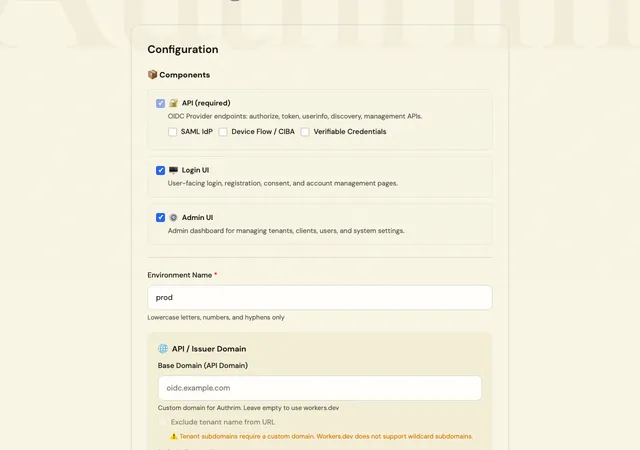
OpenID Connect, OAuth 2.0 and SAML identity provider on Workers, with a login UI for users and an admin UI for operators
- Deploy
- CLI
- License
- Apache-2.0
- GitHub stars
- 23 stars
- Last commit
Amazon Cognito is the AWS service for user sign-up, sign-in and federation that issues OAuth 2.0 and OpenID Connect tokens to applications. One listed app does its main job and runs in your own Cloudflare account.
Each answer comes from the app’s README and source code, compared with the features Amazon Cognito describes on its own site.
OpenID Connect, OAuth 2.0 and SAML identity provider on Workers, with a login UI for users and an admin UI for operators
| Feature | Authrim |
|---|---|
| User pools with sign-up and sign-in | Yes |
| Managed login (hosted UI) | Yes |
| Federation with social, SAML and OIDC providers | Yes |
| MFA | Partly |
| OAuth 2.0 / OIDC token issuance | Yes |
| Lambda triggers to customize auth flows | Partly |
| User groups for authorization | Yes |
OpenID Connect, OAuth 2.0 and SAML identity provider on Workers, with a login UI for users and an admin UI for operators