
Skip to content

Self-hosted alternatives to Mem0

Mem0 is a memory layer for AI agents and apps that stores facts from conversations and returns the relevant ones later, offered as a managed platform and as open-source software. Two listed apps do its main job and run in your own Cloudflare account.

Each answer comes from the app’s README and source code, compared with the features Mem0 describes on its own site.

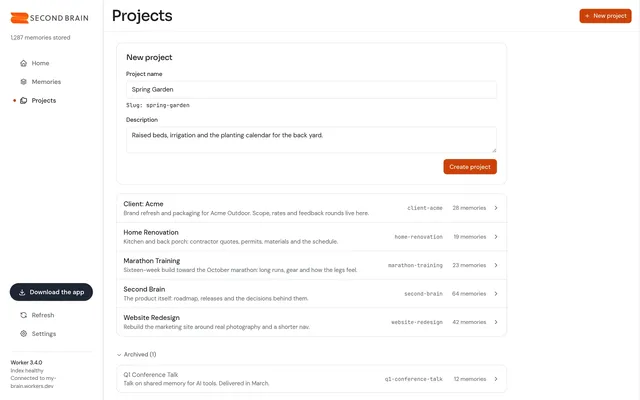
  • Second Brain dashboard Projects tab with a new project form and five projects with memory counts

    Self-hosted memory store that Claude, ChatGPT, Cursor and other MCP clients share, with recall by meaning
    Deploy
    One-click
    License
    MIT
    GitHub stars
    802 stars
    Last commit
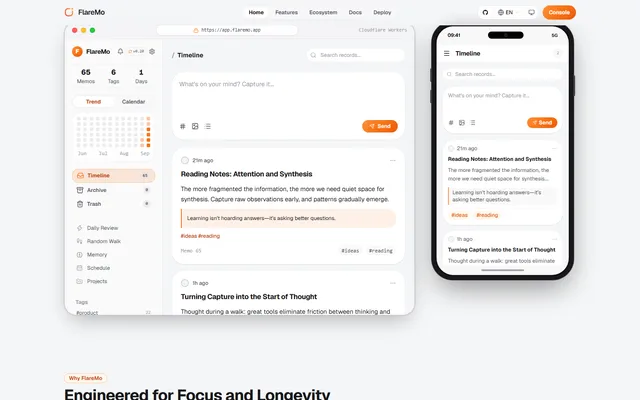
  • FlareMo timeline on desktop and phone with the note composer, a note with a highlighted quote, its tags, and counters for memos, tags and days

    Memos-style quick notes and a shared team knowledge base, with semantic search and long-term memory for AI agents

    Deploy
    One-click
    License
    AGPL-3.0
    GitHub stars
    303 stars
    Last commit

Mem0 features, app by app

FeatureSecond BrainFlareMo
Add memories from conversations through an API or SDKPartlyPartly
Automatic extraction of facts and updates to existing memoriesPartlyPartly
Semantic search that returns the most relevant memoriesYesYes
Memories scoped by user, agent, app and runPartlyPartly
Update and delete individual memoriesYesPartly
MCP server and agent plugins for coding agentsYesYes
Entity linking across memoriesPartlyPartly

Self-hosted memory store that Claude, ChatGPT, Cursor and other MCP clients share, with recall by meaning

What a Mem0 user would miss
It has no SDKs and no per-end-user, per-agent or per-run scoping for building memory into a product, no entity graph and no fact extraction from raw conversations, and the project's own comparison page says it cannot replace the Mem0 API in a product.
What it adds
Memories, vectors and the embedding and classifying models all run inside your Cloudflare account on D1, Vectorize and Workers AI, with a private Personal layer, a Shared team layer, a dashboard for editing memories and reminders for dated memories.
  • Partly Add memories from conversations through an API or SDK. REST /capture, /recall and /forget plus MCP tools and a CLI, and session-end hooks send the conversation tail to /capture; no SDK found.
  • Partly Automatic extraction of facts and updates to existing memories. Each capture is classified, checked for duplicates and contradictions and linked to related memories; no fact-by-fact extraction from conversations found.
  • Yes Semantic search that returns the most relevant memories. Recall by meaning with Vectorize and Workers AI embeddings, plus full-text search for exact names.
  • Partly Memories scoped by user, agent, app and run. Personal and Shared workspaces, projects, tags and source; no agent or run scoping found, and one shared team per brain.
  • Yes Update and delete individual memories. Update, append, forget with trash and undo, and per-memory history.
  • Yes MCP server and agent plugins for coding agents. An MCP server for Claude, ChatGPT, Cursor and Codex, plus session hooks for Claude Code, Codex CLI, Cursor, Gemini CLI and VS Code Copilot.
  • Partly Entity linking across memories. Link and connections tools create relationships between memories; no entity graph, as the project's own comparison page states.

Sources:github.com/rahilp/second-brain-cloudflarewww.thesecondbrain.dev/vs-mem0.htmldocs.mem0.ai/introduction

Memos-style quick notes and a shared team knowledge base, with semantic search and long-term memory for AI agents

What a Mem0 user would miss
It has no SDK, no per-session scope and no agent hard delete, and the memory hub ships inside a notes app, so the deployment carries the whole notes system.
What it adds
AI-written memories go through a human review queue where the user can confirm, lock, correct or delete them, and agents cannot overwrite confirmed or locked memories.
  • Partly Add memories from conversations through an API or SDK. REST, a CLI and MCP endpoints accept memories through remember and checkpoint; no SDK found.
  • Partly Automatic extraction of facts and updates to existing memories. Remember keeps version lineage by fact key and rejects exact duplicates, and a daily Workers AI pass proposes memories for human review; agents supply the facts themselves.
  • Yes Semantic search that returns the most relevant memories. Hybrid recall fuses exact key, full-text, semantic (Vectorize) and one-hop relation results.
  • Partly Memories scoped by user, agent, app and run. Scopes are global, workspace, project and agent; no per-session scope found.
  • Partly Update and delete individual memories. Newer memories supersede older ones by fact key and memory_forget archives them; agents cannot hard delete, the user deletes in the web UI.
  • Yes MCP server and agent plugins for coding agents. An MCP endpoint at /memory/mcp with seven tools, plus a CLI and a Skills playbook for Claude Code, Codex and other agents.
  • Partly Entity linking across memories. Memory_link records supersedes, contradicts and supports relations between memories; no entity graph found.

Sources:github.com/realchendahuang/flaremo/blob/main/docs/en/agent-memory.mdgithub.com/realchendahuang/flaremo#readme