Skip to content

Self-hosted alternatives to Vercel Remote Cache

Vercel Remote Cache is a hosted service that shares Turborepo task outputs, such as build and test artifacts, across a team's machines and CI. One listed app does its main job and runs in your own Cloudflare account.

Each answer comes from the app’s README and source code, compared with the features Vercel Remote Cache describes on its own site.

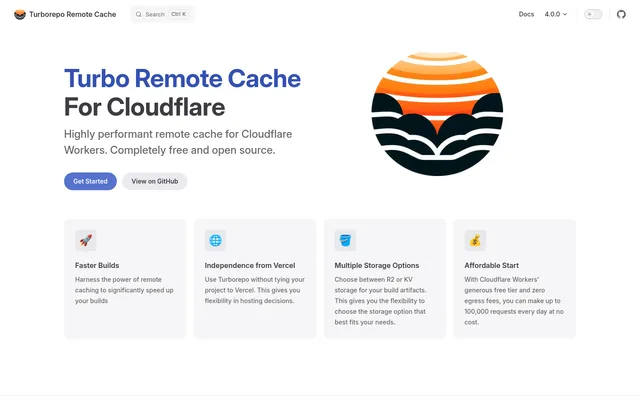
  • Turborepo Remote Cache documentation home page with the project logo and four feature cards

    Self-hosted remote cache server for Turborepo that keeps build artifacts in your own R2 bucket or Workers KV

    Deploy
    One-click
    License
    MIT
    GitHub stars
    244 stars
    Last commit

Vercel Remote Cache features, app by app

FeatureTurborepo Remote Cache
Shared cache for Turborepo task outputs across developers and CIYes
Link a repository with the turbo CLIPartly
Automatic use during Vercel buildsNo
Access from external CI with a token or OIDCPartly
Team-scoped cachePartly
Automatic artifact expiryYes
Manual cache clearingPartly
Usage and time-saved metricsNo

Self-hosted remote cache server for Turborepo that keeps build artifacts in your own R2 bucket or Workers KV

What a Vercel Remote Cache user would miss
A Vercel user would miss the turbo login flow, OIDC for CI, per-team access control, one-click cache clearing and time-saved metrics; the Worker has no interface.
What it adds
MIT licensed, keeps artifacts in your own R2 bucket or Workers KV, and sets retention with BUCKET_OBJECT_EXPIRATION_HOURS.
  • Yes Shared cache for Turborepo task outputs across developers and CI. Implements the Turborepo v8 artifacts API with PUT, GET and HEAD routes backed by R2 or Workers KV.
  • Partly Link a repository with the turbo CLI. No turbo login flow; clients set TURBO_API, TURBO_TEAM and TURBO_TOKEN in the environment.
  • No Automatic use during Vercel builds. Not documented; the README covers local machines and external CI.
  • Partly Access from external CI with a token or OIDC. One shared bearer token (TURBO_TOKEN) for CI and developers; no OIDC.
  • Partly Team-scoped cache. Artifacts are stored under the TURBO_TEAM or slug value, but one token covers every team.
  • Yes Automatic artifact expiry. A daily Cron Trigger deletes objects older than BUCKET_OBJECT_EXPIRATION_HOURS, 720 hours by default.
  • Partly Manual cache clearing. No dashboard; an authenticated POST /internal/delete-expired-objects accepts an expireInHours value.
  • No Usage and time-saved metrics. The events endpoint accepts hit and miss events but does not store them (a TODO in the source), and there is no dashboard.

Sources:github.com/adirishi/turborepo-remote-cache-cloudflareadirishi.github.io/turborepo-remote-cache-cloudflare/vercel.com/docs/monorepos/remote-caching