Skip to content

Self-hosted alternatives to Atlassian Statuspage

Statuspage is Atlassian's hosted service for publishing a status page with component status, incident updates and scheduled maintenance. Two listed apps do its main job and run in your own Cloudflare account.

Each answer comes from the app’s README and source code, compared with the features Atlassian Statuspage describes on its own site.

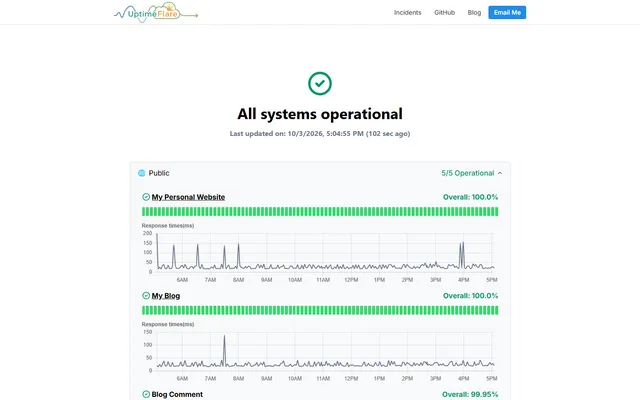
  • UptimeFlare status page reporting all systems operational, with daily uptime bars and response-time charts

    Serverless uptime monitor and status page with HTTP, TCP and keyword checks, deployed through GitHub Actions
    Deploy
    Manual
    License
    Apache-2.0
    GitHub stars
    3.9k stars
    Last commit
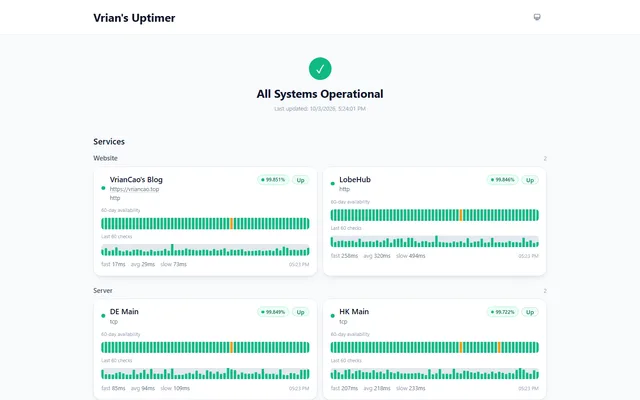
  • Uptimer public status page with website and server monitors, 60-day availability bars and latency of the last 60 checks

    Uptime monitor and status page with HTTP and TCP checks, incidents and webhook alerts, on Workers, Pages and D1

    Deploy
    Manual
    License
    MIT
    GitHub stars
    481 stars
    Last commit

Atlassian Statuspage features, app by app

FeatureUptimeFlareUptimer
Public status page with component statusYesYes
Incident updates from investigating to resolvedPartlyYes
Scheduled maintenance announcementsYesYes
Email, SMS and webhook notifications to subscribersNoNo
Custom domain and brandingYesPartly
Uptime history and metrics on the pageYesYes
Private pages for staff or specific audiencesYesNo
REST API and integrations with monitoring toolsPartlyPartly

Serverless uptime monitor and status page with HTTP, TCP and keyword checks, deployed through GitHub Actions

What a Atlassian Statuspage user would miss
Incidents are recorded automatically and cannot be posted or updated by hand, maintenance is edited in a config file, and visitors cannot subscribe.
What it adds
It runs its own HTTP, TCP and keyword checks, including checks from a chosen region, so the status page needs no separate monitoring tool.
  • Yes Public status page with component status. Status page with grouped monitors and current status.
  • Partly Incident updates from investigating to resolved. Incident history is built from detected downtime; messages cannot be posted by hand.
  • Yes Scheduled maintenance announcements. Scheduled maintenance entries in the config file, shown as ongoing and upcoming notices.
  • No Email, SMS and webhook notifications to subscribers. Webhook alerts go to the operator; visitors cannot subscribe.
  • Yes Custom domain and branding. Own domain through a CNAME, plus configurable title, links, logo and footer.
  • Yes Uptime history and metrics on the page. Uptime percentage, 90-day history and response time charts.
  • Yes Private pages for staff or specific audiences. Optional password for a private status page.
  • Partly REST API and integrations with monitoring tools. JSON status API and iframe embed of a monitor; no write API.

Sources:github.com/lyc8503/uptimeflare#featuresgithub.com/lyc8503/UptimeFlare/blob/main/uptime.config.tsgithub.com/lyc8503/UptimeFlare/wiki/Setup-notification

Uptime monitor and status page with HTTP and TCP checks, incidents and webhook alerts, on Workers, Pages and D1

What a Atlassian Statuspage user would miss
Visitors cannot subscribe to updates, and there is no private page, logo or custom CSS setting.
What it adds
It runs its own HTTP and TCP checks, so the page's status comes from the same app, and the page is available in five languages.
  • Yes Public status page with component status. Public page with aggregate status, monitor groups and per-monitor uptime.
  • Yes Incident updates from investigating to resolved. Incidents with investigating, identified, monitoring and resolved states and a timeline of updates.
  • Yes Scheduled maintenance announcements. Scheduled maintenance windows shown on the page.
  • No Email, SMS and webhook notifications to subscribers. Webhook channels notify the operator; visitors cannot subscribe.
  • Partly Custom domain and branding. Site title and description settings only; no logo, CSS or domain setup in the app.
  • Yes Uptime history and metrics on the page. Uptime percentages and latency charts.
  • No Private pages for staff or specific audiences. The status page is public.
  • Partly REST API and integrations with monitoring tools. Public JSON status endpoint and webhook notifications; no other integrations found.

Sources:github.com/vriancao/uptimer#featuresgithub.com/VrianCao/Uptimer/blob/master/docs/notifications.mdgithub.com/VrianCao/Uptimer/blob/master/apps/worker/src/schemas/incidents.ts